Built around your buyer

Kitchenware programmes for different buyers.

Your customer and sales channel shape the product, packaging and commercial brief. Whether you are launching a brand, building a retail assortment or sourcing for hospitality, start with what the range needs to do.

The scenarios below are illustrative briefs, not customer case studies or confirmed product configurations.

Brands and new launches

Build a range around a clear customer need, then connect the product, logo and packaging. Begin with a manageable shortlist and identify which features make the range yours.

Example starting point

A new brand is comparing a pizza cutter and a rocker knife for a coordinated retail pack.

Include in your brief

  • Target customer, product references and quantity per item
  • Logo artwork, desired finish and packaging direction
  • Launch priorities and sample decisions still open

Retail buyers

Choose products that have a distinct role on the shelf. Review the usable dimensions, assortment, pack presentation and label information together so each item fits the retail brief.

Example starting point

A retailer wants a serving tray, fruit bowl and napkin holder with a consistent presentation.

Include in your brief

  • Shelf or display dimensions and proposed assortment
  • Packaging, barcode and information requirements
  • Quantity by item, sales market and intended delivery window

Distributors and wholesalers

Make quotations comparable across the range. Define the material and construction requirements, unit packaging and order basis for each product, then clarify manufacturing and sourcing responsibilities.

Example starting point

A distributor is comparing a turner, skimmer and ladle for a cooking-tool assortment.

Include in your brief

  • Product list and specifications that must stay consistent
  • Quantity per configuration, packing and carton requirements
  • Destination and repeat-order requirements to discuss

Hospitality and foodservice buyers

Start with the preparation, cooking, serving or bar task. Handling, cleaning, storage and the intended contact with food belong in the brief alongside appearance.

Example starting point

A hospitality buyer is reviewing shaker fit and serving-tray handling for a bar programme.

Include in your brief

  • Use setting, dimensions, capacity and storage constraints
  • Cleaning expectations and the sample checks you need
  • Quantity, destination and any buyer-required documents

Made in our Yangjiang factory

One factory behind every buyer type.

Brands, retailers, distributors and hospitality buyers are all supplied from our Yangjiang factory. Every product in the catalogue is made here, then counted and packed by order.

  1. Operator feeding parts into a mechanical press

    Pressing

    Pressing and forming on our own presses.

    A bay of open-back mechanical presses, including 40-tonne units, blanks, pierces and forms steel parts with dedicated tooling.

  2. Crates of parts sorted by order in the staging area

    Staging & dispatch

    Counted, packed and staged by order.

    Finished parts are counted into crates by order, then packed and staged in the main hall for loading.

Photographed in our factory by our own team. Take the full factory tour

Selling online

Connect the listing to the product and pack.

Marketplace and ecommerce sellers need a consistent record of what the customer receives. Define the product dimensions, included pieces, protective parts and care information before finalising listing content.

Share the parcel-delivery or fulfilment requirements for your channel. A presentation sample can show appearance and fit; any required transit or performance assessment needs its own agreed scope. Avoid relying on lifestyle imagery to establish included accessories or product measurements.

Review the packaging checklist

Supplier set-up

Registered details for your vendor file.

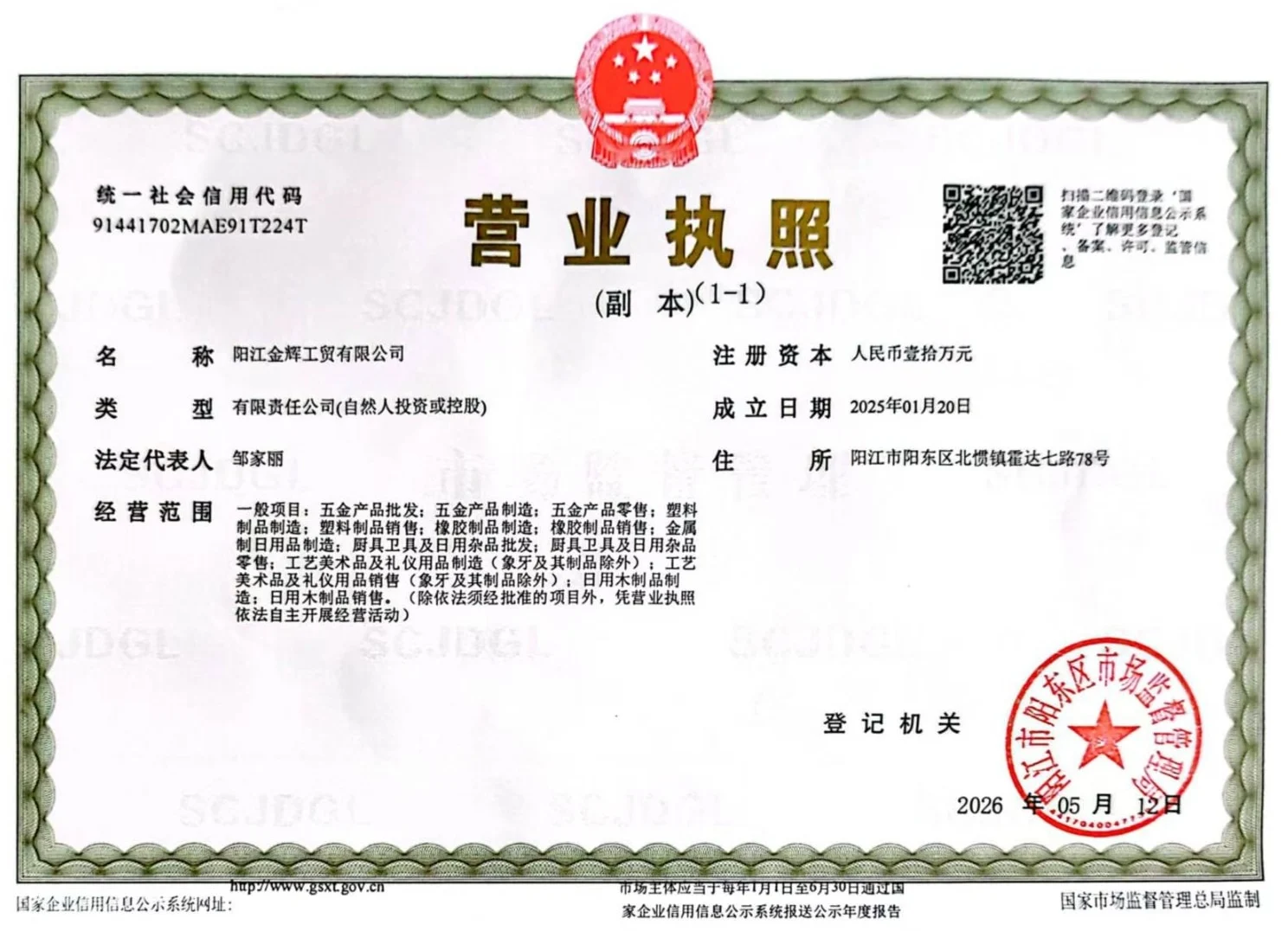
Retailers and distributors usually ask for a supplier’s registered company details before a first order. KOVA Tough trades through the company below, licensed by the market regulator in Yangjiang.

Registered company
Yangjiang Jinhui Industry and Trade Co., Ltd.阳江金辉工贸有限公司
Credit code
91441702MAE91T224T
Registered address
No. 78 Huoda 7th Road, Beiguan Town, Yangdong District, Yangjiang City, Guangdong Province, China阳江市阳东区北惯镇霍达七路78号
Issued by
Yangdong District Administration for Market Regulation, Yangjiang, 12 May 2026

Check the credit code on China’s National Enterprise Credit Information Publicity System.

Business licence of Yangjiang Jinhui Industry and Trade Co., Ltd., showing its unified social credit code, registered address and the registration authority's seal. Opens at full size.
Business licence, issued 12 May 2026. Select to view at full size.

A shared foundation

Make the next decision easier.

For every buyer type, identify the exact product or reference, intended country, quantity per item and any requirements that cannot change. Then separate the questions about construction, branding, packaging and documentation.

Minimum orders start from 100 units, with the applicable basis confirmed for the selected configuration. Include the quantity you want rather than assuming a single minimum covers every SKU, colour or package.

If you are comparing supply routes, use our customisation guide to distinguish a buyer-specified OEM project, an adaptation of an existing direction and a private-label range.

Choose your project route

Your buyer. Your brief.

Start with the range you need.

Tell us who will use the products, how you will sell them and which decisions you need help resolving. Add your product shortlist, quantities and target market.

Prepare an enquiry