of manufacturing experience behind the new KOVA Tough brand.

Our factory · Yangjiang, Guangdong
The Yangjiang factory behind international kitchenware brands.
For 20 years, our Yangjiang factory has made kitchenware for international brands. KOVA Tough is the brand we created to work with business buyers directly. Cutting, pressing, tooling, moulding and assembly all happen in our own factory, so your product is developed where it is made.
Metal parts hung on electroplating racks in our factory. All photographs on this page were taken on site.
laser cutting, pressing, toolroom, moulding, welding and assembly.
a minimum-order starting point, confirmed for the selected configuration.
a centre of China’s knife and kitchenware industry, in Guangdong Province.
A new brand. An established factory.
Your order is made in our own factory.
The manufacturing history belongs to the established business behind KOVA Tough. KOVA Tough is the brand we created to present that factory to brands, retailers and other business buyers, with a clear way to begin a project.
Every product in the catalogue is made here: preparation tools and gadgets, cooking utensils, serveware, tabletop accessories, barware and knives. Start with a single tool or compare several products for a coordinated range.
Explore the kitchenware catalogue →

Factory tour
From steel sheet to a packed order.
Follow a product through the factory in production order. Each stage is run by our own team, on our own equipment, against the sample you approve.
Materials
Material in, identified by component.
Stainless steel sheet, wire and plastics are received into dedicated storage bays. Plastic granules (PE, PP, ABS and PVC) arrive in bags and bulk bags and feed our injection moulding machines, which mould knife handles and housings for kitchen appliances. Sheet is moved with jib cranes and a vacuum lifter so surfaces stay flat and unmarked, and wire stock is kept wrapped on pallets until forming. Your specification names the grade or plastic type and the thickness of each component, and the sample confirms it.
Typical parts
- Stainless steel sheet
- Wire
- Plastics: PE, PP, ABS, PVC


Laser cutting
Blanks cut straight from the drawing.
Sheet is lifted onto the bed of an HSG laser cutting machine, which profiles flat blanks from the drawing. Changing an outline, a hanging hole or a logo cut-out is a programme change rather than a new cutting tool, which keeps early samples quick to revise.
Typical parts
- Pizza peel and tray blanks
- Grater plates
- Spatula and turner heads


Pressing
Pressing and forming on our own presses.
A bay of open-back mechanical presses, including 40-tonne units, blanks, pierces and forms steel parts with dedicated tooling. A four-column hydraulic press handles deeper forming. Operators run each part against the approved sample.
Typical parts
- Turner and skimmer heads
- Ladle bowls
- Pizza cutter wheels
- Garlic press bodies


Tooling
Press tools and moulds made in our toolroom.
Tooling is machined and maintained in our own toolroom, with CNC machining centres, milling and surface grinding. A mould store with an overhead crane keeps the tooling for repeat orders on site, so a design change is discussed with the people who cut the tool.
Typical parts
- Press tools
- Injection moulds
- Fixtures and gauges


Moulding
Handles and plastic parts moulded in-house.
Haitian injection moulding machines, with robotic take-out on the larger cells, produce handles, grips and plastic components. Colour, texture and logo details are set in the mould and checked on the first parts off the machine.
Typical parts
- Utensil and knife handles
- Garlic press and grater grips
- Protective covers


Surface treatment
Racked for electroplating.
Finished metal parts are hung on purpose-made racks for galvanic coating, also called electroplating. The racks are fixtures, not products: they hold each part in place while an electrochemical reaction deposits a thin protective metal layer on its surface. The coating protects against corrosion, improves durability and wear resistance, and can give a decorative finish. It is a surface treatment stage, separate from welding and final assembly, and the finish is checked against the approved sample.
What the coating does
- Corrosion protection
- Durability and wear resistance
- Decorative finish


Staging & dispatch
Counted, packed and staged by order.
Finished parts are counted into crates by order, then packed and staged in the main hall for loading. Your pack-out, carton marks and final inspection stage are agreed in the brief, before production starts.
Typical parts
- Retail and bulk packing
- Carton marks
- Final inspection


On the factory floor
Machines running, not staged.
Short clips filmed on site by our team. They play silently while on screen; select a clip to pause it.
More from the factory
A closer look around the site.
Select any photograph to view it at full size.
Design, material and volume
Three decisions to agree before production.
Every order starts from the same three decisions, in this order. Together they define what we make, what it is made from, and how many we make and by when.
Design & drawing
Approve the drawing first.
Before we can produce anything, the design must be agreed. This includes 2D drawings, 3D models, dimensions, tolerances, material thickness, and joint details. The drawing defines exactly what the product looks like and how it is constructed. Without an approved drawing, production cannot begin.
Material & finish
Confirm material and finish on the sample.
This decision covers what the product is made from and how it is treated. It includes the grade of stainless steel or the type of plastic (PE, PP, ABS, PVC), as well as the final surface treatment such as galvanic coating, colour, and texture. All of this is confirmed on the approved sample.
Volume & timeline
Set the quantity and the ship date.
This decision covers how many units are needed and when they are required. It includes the minimum order quantity (MOQ), total production volume, lead times, and the shipping date. MOQ can vary depending on the product, and this directly affects both the price and the schedule.
A clear working brief
Know what to bring and what to confirm.
Your product requirements shape the conversation. Use these checkpoints to keep the product, sample and quotation connected, including when a project combines several items.
Swipe or scroll the table to compare all columns.
| Stage | Your starting information | Confirm together |
|---|---|---|
| Product brief | Describe the task, reference, quantity and destination. Identify requirements that must stay fixed. | Feasible construction, material options and the production route in our factory. |
| Sample review | Review the sample against your requirements and record requested changes. | Sample version, accepted features, outstanding decisions and any revised scope. |
| Branding and packaging | Supply artwork, proposed contents and sales-channel requirements. | Logo placement, product protection, artwork version and complete pack-out. |
| Quality and documents | Identify destination-market and buyer requirements. | Inspection responsibilities, document scope and any independent testing required. |
Business details
A registered company and a direct conversation.
KOVA Tough trades through the registered company below. Send a product reference, quantity per item and intended market. If you have drawings, artwork or sample requirements, email them with your company name so they can be considered alongside the brief.
- Registered company
- Yangjiang Jinhui Industry and Trade Co., Ltd.阳江金辉工贸有限公司
- Credit code
- 91441702MAE91T224T
- Registered address
- No. 78 Huoda 7th Road, Beiguan Town, Yangdong District, Yangjiang City, Guangdong Province, China阳江市阳东区北惯镇霍达七路78号
- Issued by
- Yangdong District Administration for Market Regulation, Yangjiang, 12 May 2026
- Enquiries
- info@kovatough.com
Check the credit code on China’s National Enterprise Credit Information Publicity System.
Prepare your enquiry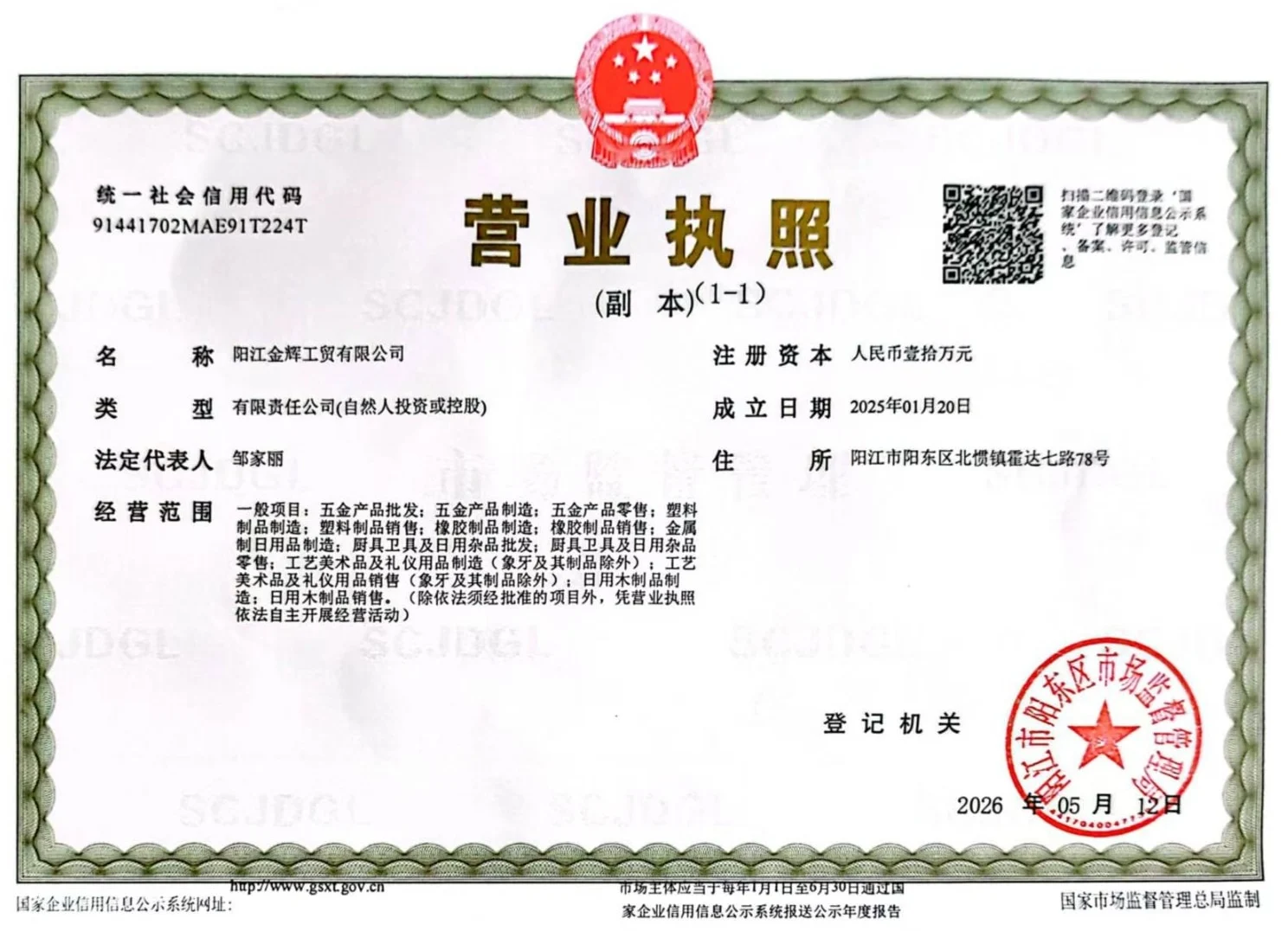
Quality built into the working relationship
A factory brief includes your compliance checklist.
Our factory experience helps us turn buyer requirements into practical decisions about materials, samples, checks and documentation. Share your required standards, certificates and retailer audit checklist at the start, so we can plan the work around your product.
Explore standards, testing & documentation →Food contact & materials
FDA · LFGB · EU food contact · REACH · Proposition 65
Plan food-contact and chemical assessments around the component materials, coatings, intended use and sales market.
Factory systems & audits
ISO 9001 · amfori BSCI · Sedex / SMETA
Bring your supplier-approval checklist. We review the required management-system documentation, social-audit scope and manufacturing site with you.
Product conformity & inspection
CE · RoHS · AQL · Pre-shipment inspection
Identify applicable product conformity requirements and agree inspection criteria. CE and RoHS apply to relevant product categories, including applicable electrical products.
Agree the evidence before production.
For EU food-contact projects, the review can include EC 1935/2004, GMP under EC 2023/2006, EU 10/2011 for applicable plastics and relevant BfR recommendations. The selected material and use determine the assessment.
Keep the documents connected to the order.
Match product reports to the agreed configuration, and factory certificates or audit records to the entity and site they cover. Include sample approval, independent inspection and any document-review steps in your project schedule.
Requirements are confirmed by product and project. The names above describe requirements to discuss, rather than certificates held by every product or factory.
Discuss your compliance checklist